

Tingling in your hands can be a deeply concerning symptom that interferes with your daily activities, whether you are typing at a desk, driving, or trying to get a good night’s sleep. While many people immediately jump to conclusions and worry about conditions like Thoracic Outlet Syndrome (TOS), the reality is that hand tingling can originate from several different anatomical structures. This fact sheet is designed to help you understand the potential reasons behind your symptoms and how targeted care can help you find lasting relief.
In this article, Dr. Simon Nash (Chiropractor) discusses the common causes of hand tingling, why it is not always Thoracic Outlet Syndrome, and how a comprehensive clinical evaluation can identify the root cause of your discomfort.
Please note: The information provided in this article is for general knowledge and informational purposes only, and does not constitute medical advice. It is essential to consult with a qualified healthcare professional for a formal diagnosis and personalised treatment plan
Table of Contents
- Understanding Hand Tingling and Nerve Compression
- What is Thoracic Outlet Syndrome?
- Other Common Causes of Hand Tingling
- The Chiropractic Approach to Hand Tingling
- Frequently Asked Questions (FAQs)
- Book a Consult with Our Chiro Brisbane
- References
- Video Transcript
Understanding Hand Tingling and Nerve Compression
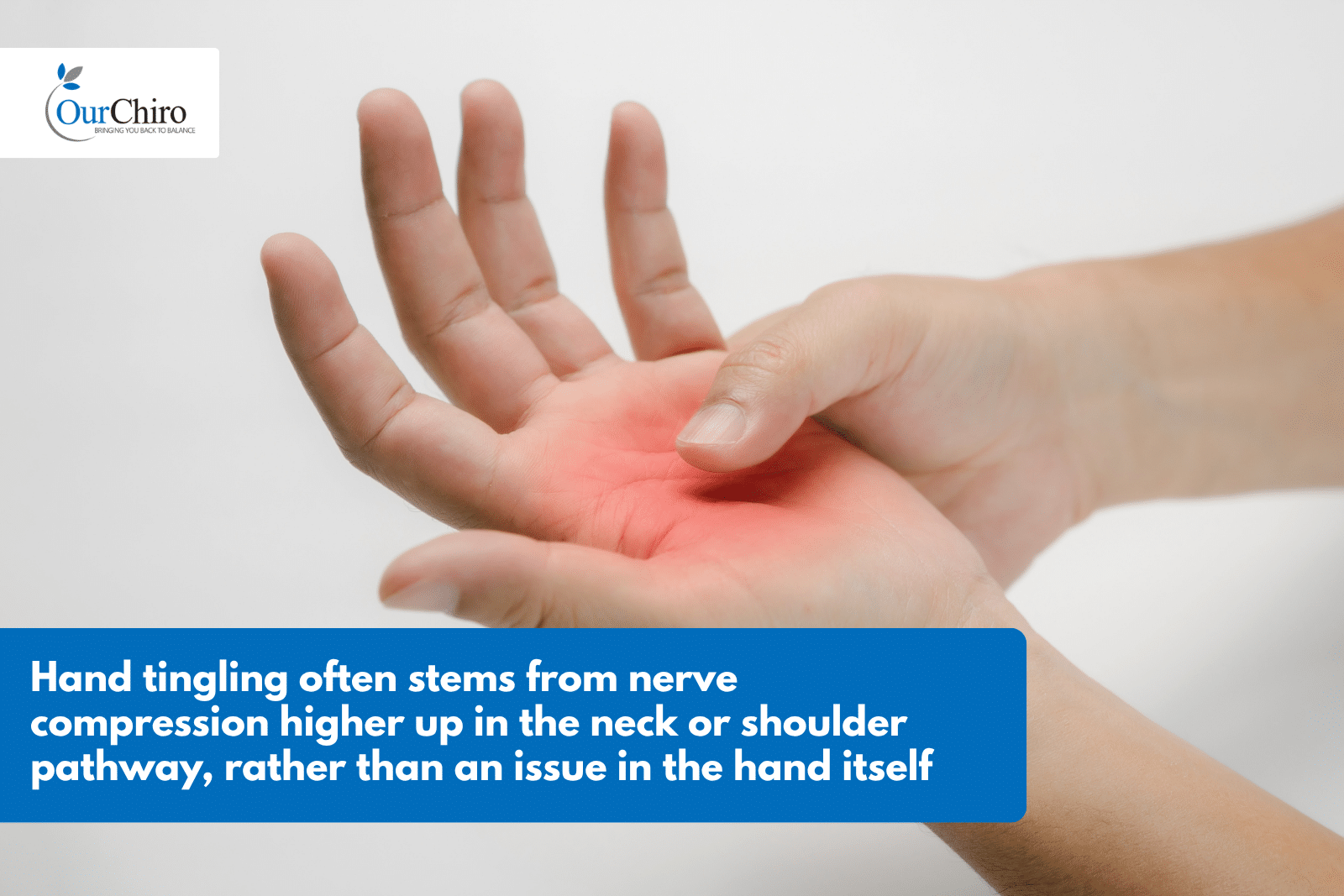
Experiencing a “pins and needles” sensation or numbness in your fingers and hands is typically a sign of paresthesia, a clear signal that a nerve supplying the upper limb is irritated, compressed, or lack of blood flow is affecting its function.
The nerves that supply your hands originate in your cervical spine (neck), travelling down through a complex pathway past the shoulder, collarbone, elbow, and wrist. An interruption or compression at any point along this nervous system pathway can manifest as tingling in your hands. When a patient presents to our Brisbane clinic with these symptoms, they often feel anxious and assume they have a serious structural issue like Thoracic Outlet Syndrome. A common example is a patient whose hands tingle while working at the computer or on waking. After a thorough physical examination, the cause often turns out to be something more manageable, such as tight scalene muscles or irritation of a neck joint. Finding this out is usually a big relief, because it gives the patient a clear path forward.
What is Thoracic Outlet Syndrome?
Thoracic Outlet Syndrome (TOS) refers to a group of disorders that occur when the blood vessels or nerves in the space between your collarbone and your first rib (the thoracic outlet) become compressed.
“Thoracic outlet syndrome is where we have a compression of the nerves and blood vessels up through here,” explains Dr. Nash.
“And there’s a few different reasons or causes for thoracic outlet syndrome, such as tight scalene muscles, a few congenital conditions with the ribs.”
When compression occurs in this narrow passageway, it can cause neck and shoulder pain, numbness, and tingling in the fingers. A 2007 literature review by Vanti and colleagues found that conservative treatment, such as physiotherapy, appeared to help reduce TOS symptoms and improve function. However, the authors noted that high-quality evidence was limited and that the best type of conservative care is not yet clear (Vanti et al., 2007).
Other Common Causes of Hand Tingling
Because the nerve pathway extends all the way from the neck to the fingertips, several other issues can mimic or cause hand tingling:
1. Cervical Disc Bulges: The nerve roots that branch out into your arms originate in the neck (cervical spine). A herniated or bulging disc in the cervical spine can press directly on these nerve roots, sending radiating pain, numbness, or tingling straight down into the hands.
2. Facet Joint Arthritis and Degeneration: “You could have facet arthritis or facet degeneration, which are the little joints that make up the spine,” Dr. Nash states. When these spinal joints undergo wear and tear or become inflamed, nearby nerves can become irritated, referring abnormal sensations down the upper extremities.
3. Muscle Tension and Poor Posture: In our modern workplace environment, poor ergonomics and posture are massive contributors to upper limb symptoms. “You could simply just have tight muscles and poor posture,” notes Dr. Nash.
Extended hours hunched over keyboards can lead to chronic tightness in the neck, chest, and shoulder girdle, which may contribute to nerve irritation. A 2023 randomised controlled trial found that corrective exercise programs, including stretching and self-myofascial release, improved forward head posture in young adults (Titcomb et al., 2023).
The Chiropractic Approach to Hand Tingling
Determining the exact source of nerve irritation is crucial for effective care.
“Having tingling in your hands doesn’t necessarily mean you have thoracic outlet syndrome, but obviously you need to be checked out by a health professional if you do have any type of tingling in your hands,” advises Dr. Nash.
At Our Chiro Brisbane, our clinical process involves:
- Comprehensive Assessment: Performing physical, neurological, and orthopaedic testing to locate the exact site of nerve entrapment and whether it is in the cervical spine, thoracic outlet, elbow, or wrist.
- Targeted Interventions: Utilising gentle spinal adjustments, joint mobilisations, and soft tissue therapy to reduce pressure on compressed nerves. You can learn more about how our team approaches neck and upper body alignment on our Chiropractic Services page.
- Ergonomic & Postural Rehabilitation: Providing custom exercises and workplace postural advice to prevent symptom recurrence. Explore our targeted Remedial Massage and Soft Tissue Services to see how dedicated soft tissue work assists in relieving muscle tension around the neck and shoulder girdle.
Frequently Asked Questions (FAQs)
Q1: Does tingling in the pinky finger mean I have Thoracic Outlet Syndrome? A: Tingling in the ring and pinky fingers is often associated with the ulnar nerve, which can be compressed at the thoracic outlet, but it can also be trapped at the elbow (cubital tunnel) or neck. A clinical exam is necessary to isolate the site.
Q2: Can stress cause tingling in the hands? A: It can contribute. Stress often leads to shallow breathing and raised shoulders, which can tighten the scalene muscles in the neck. In some people, this tightness may irritate nearby nerves.
Q3: How do I know if my hand tingling is coming from my neck? A: If your tingling changes when you move, turn or bend your neck, it may be coming from the neck, for example from a disc bulge or facet joint issue. A clinical assessment is needed to confirm this.
Q4: Can poor posture really cause hand tingling? A: It can contribute. Forward head posture and rounded shoulders can place extra load on the nerves and blood vessels running from the neck to the arm, which may lead to numbness or tingling in some people.
Q5: What should I do if I wake up with tingling hands every morning? A: Waking up with hand tingling can result from sleeping positions that compress nerves at the neck, shoulder, or wrist. You should seek an evaluation from a healthcare provider to check your alignment and joint function.
Q6: Is Thoracic Outlet Syndrome serious? A: While neurogenic TOS can be uncomfortable and disruptive, many cases respond very well to conservative management, physical therapy, and postural correction when caught early.
Q7: When should I seek immediate medical attention for hand tingling? A: You should seek urgent medical care if your hand tingling is accompanied by sudden facial drooping, sudden loss of strength, speech difficulties, or severe sudden chest pain.
Book a Consult with Our Chiro Brisbane
We understand how frustrating and unsettling hand tingling can be. It makes simple tasks like typing, holding a coffee cup, or sleeping peacefully feel challenging, leaving you wondering if something serious is wrong. You don’t have to navigate this uncertainty alone.
At Our Chiro Brisbane, we are committed to listening to your concerns, getting to the root cause of your symptoms, and supporting you with compassionate, personalised care. Whether your symptoms stem from posture, muscle tightness, or nerve compression, we are here to help you move comfortably again. Take the first step toward finding answers and relief.
Book an appointment with Our Chiro Brisbane today or call (07) 3257 0399
References
Vanti, C., Natalini, L., Romeo, A., Tosarelli, D., & Pillastrini, P. (2007). Conservative treatment of thoracic outlet syndrome. A review of the literature. Europa Medicophysica, 43(1), 55–70. https://pubmed.ncbi.nlm.nih.gov/16955064/
Titcomb, D. A., Melton, B. F., Miyashita, T., & Bland, H. W. (2023). The effects of postural education or corrective exercise on the craniovertebral angle in young adults with forward head posture: A randomized controlled trial. International Journal of Exercise Science, 16(1), 954–973. https://pmc.ncbi.nlm.nih.gov/articles/PMC10464763/
Video transcript
A question we often get asked is, if I have tingling in my hands, do I have thoracic outlet syndrome? And the answer to that is not necessarily. Thoracic outlet syndrome is where we have a compression of the nerves and blood vessels up through here. And there’s a few different reasons or causes for thoracic outlet syndrome, such as tight scalene muscles, a few congenital conditions with the ribs. But we don’t always or necessarily have tingling hands because of thoracic outlet syndrome. Other causes could be disc bulges. You could have facet arthritis or facet degeneration, which are the little joints that make up the spine. You could simply just have tight muscles and poor posture. So having tingling in your hands doesn’t necessarily mean you have thoracic outlet syndrome, but obviously you need to be checked out by a health professional. If you do have any type of tingling in your hands
This blog post was written and approved by Dr Simon Nash
Dr Simon Nash (M.Chiro, B.Chiro Sci.) is a chiropractor with over 20 years of clinical experience. He is a full professional member of Sports Medicine Australia (SMA) and Chiropractic Australia, and is AHPRA registered (CHI0000970189). Simon graduated from Macquarie University and is dual-registered to practise in Australia and Hong Kong.
He began his career in a multidisciplinary neurology-focused clinic in Sydney, developing a strong interest in treating headaches and migraines. Since 2006, he has operated Our Chiro Brisbane, now alongside his sisters Jessica and Rebecca.
Simon treats everyday injuries, workplace rehabilitation cases and complex presentations using a wide range of techniques. His sports medicine experience spans elite athletes including NRL and Rugby Union players, Olympians, and events like the Australian Open and Hong Kong 7s. He has also treated Guns N’ Roses during tour.


Disclaimer:
The information provided in this blog is for general informational purposes only and is not intended as medical advice. It should not be used to diagnose, treat, or replace professional consultation with a qualified healthcare provider. Always seek the advice of a chiropractor, GP, or other qualified health professional regarding any medical condition or treatment.
Click here to learn more about our editorial policy, that explains how content is created, fact-checked, and updated by qualified chiropractors and other health professionals.