

Muscle knots have a way of causing trouble well beyond the spot where they sit. A tight band in the shoulder can send an ache down the arm; one in the neck can turn into a headache behind the eye. These sensitive spots are known as trigger points, and they’re one of the most common, and most commonly overlooked sources of everyday musculoskeletal pain.
In this article, Dr. Simon Nash (Chiropractor) discusses what trigger points are, why they form, and how trigger point therapy may offer a simple, non-invasive path to relief.
Medical Disclaimer: The information provided in this article is for general knowledge and informational purposes only, and does not constitute medical advice. It is essential to consult with a qualified healthcare professional for a diagnosis and personalised treatment plan.
Table of Contents
- Understanding Trigger Points and Referred Pain
- What Is Trigger Point Therapy?
- Common Causes of Trigger Points
- How Chiropractors Identify Trigger Points
- The Chiropractic Approach to Trigger Point Therapy
- Frequently Asked Questions (FAQs)
- Book a Consult with Our Chiro Brisbane
- References
- Video Transcript
Understanding Trigger Points and Referred Pain
A trigger point is a hyperirritable spot within a taut band of muscle fibre, what most people call a knot. It feels tender under the thumb, but the more important feature is what it does to the area around it.
“A trigger point usually refers pain from a muscle,” Dr. Nash explains. “So you might get pain that runs down the arm. That can sometimes be a trigger point.”
This is what makes trigger points so easy to misread. The place that hurts is often not the place that’s causing the problem. An ache down the forearm, a headache at the base of the skull, or a nagging pain through the glute can all originate from a trigger point in a completely different muscle. Chasing the symptom without finding the source tends to produce short-lived relief at best.
In the clinical literature, this pattern of local and referred pain arising from taut bands in muscle is described as myofascial pain syndrome, and it’s one of the most frequently encountered soft tissue presentations in musculoskeletal practice (Lu et al., 2022).
What Is Trigger Point Therapy?
“A question that we often get in the clinic is: what’s trigger point therapy?” says Dr. Nash.
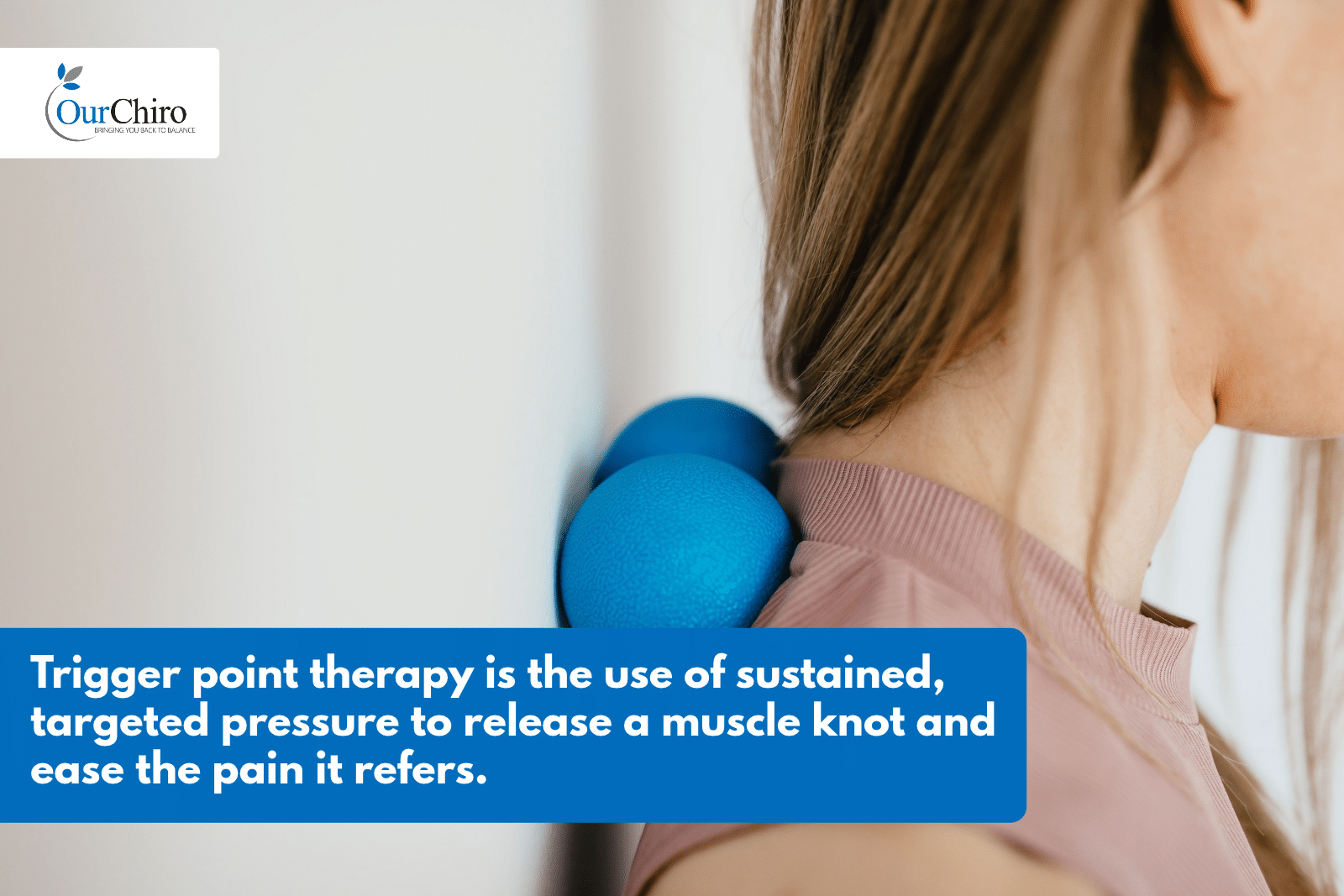
The answer is refreshingly straightforward. “Trigger point therapy is a specialised little technique that we use where you apply sustained pressure to a knot or a trigger point,” he explains.
Rather than rubbing or kneading the area, the chiropractor locates the specific point and holds steady, controlled pressure on it. “So we apply a specialised pressure to that trigger point and we hold that pressure down, which helps relieve the muscle, promote blood flow and reduce tension in that muscle.”
In research settings this technique is usually referred to as ischaemic compression or manual pressure release, and typically involves sustained pressure held for somewhere between 30 and 90 seconds at a time (Lu et al., 2022).
The goal isn’t just to make the sore spot feel better in the moment. As Dr. Nash puts it, the aim is “ultimately relieving that pain and tension, so the muscle can then act a lot more normal and not under a stressful load.”
Common Causes of Trigger Points
Trigger points tend to develop where a muscle is asked to do more than it comfortably can. Either too much in one burst, or a little extra load for too long. Common contributors include:
- Sustained postures — long hours at a desk, driving, or looking down at a phone
- Repetitive movements — mouse and keyboard use, trade work, repetitive lifting
- Acute overload — a heavy gym session, a weekend of moving furniture, or an awkward lift
- Injury and guarding — muscles that tighten protectively after a strain or whiplash
- Stress and shallow breathing — particularly through the neck, jaw, and upper shoulders
- Underlying joint restriction — when a joint isn’t moving well, surrounding muscles often overwork to compensate
That last point matters. Trigger points rarely exist in isolation, which is why assessing the joints and movement patterns around the affected muscle is part of a thorough approach.
How Chiropractors Identify Trigger Points
Finding a trigger point is a hands-on process. It begins with a discussion of your symptoms. Where the pain is, what it feels like, what aggravates and eases it, and whether it travels.
From there, the chiropractor will palpate the muscle groups most likely to be involved, feeling for a taut band and then for the specific tender nodule within it. The confirming sign is usually reproduction of your familiar pain. When pressure on the point recreates the ache you’ve been experiencing elsewhere, that’s a strong indication the right structure has been found.
Assessment also includes looking at range of motion, muscle strength, joint mechanics, and posture, because the trigger point is often the downstream result of something else. It’s also important to rule out other causes of referred pain. Nerve root irritation from the spine, for example, can produce arm or leg symptoms that superficially resemble a trigger point referral pattern but need a different approach.
The Chiropractic Approach to Trigger Point Therapy
Trigger point therapy is rarely used on its own. At Our Chiro Brisbane, it’s typically one component of a broader treatment plan tailored to your presentation. Depending on what the assessment reveals, care may include:
Trigger Point Therapy (Ischaemic Compression): Sustained, controlled pressure applied directly to the trigger point to reduce tension, encourage blood flow, and settle the referred pain. Meta-analysis of randomised controlled trials has found that ischaemic compression produces statistically significant improvements in pressure pain threshold compared with control conditions in people with myofascial pain (Lu et al., 2022).
Broader Soft Tissue Therapy: Working through the wider muscle group and fascia so the released trigger point isn’t immediately reloaded by surrounding tension.
Dry Needling: Using fine sterile needles to target trigger points directly, which can be particularly useful for deeper or more stubborn points that are hard to reach with manual pressure.
Manual Adjustments and Mobilisations: Restoring normal joint movement so the muscle no longer has to compensate for a restricted segment.
Stretching and Movement Retraining: Helping the muscle return to its full resting length after the point has been released.
Exercise Prescription and Load Management: Building capacity in the muscles that were struggling, and adjusting the daily demands that created the problem in the first place.
Ergonomic and Postural Advice: Addressing the desk setup, sleeping position, or work habit that keeps recreating the same knot.
Reviews of manual therapy for trigger points have consistently found that manual techniques can reduce pain and improve pressure pain threshold, with the strongest results when treatment is combined with stretching, exercise, and management of the underlying cause rather than used as a standalone fix (Fernández-de-las-Peñas et al., 2005; Xu et al., 2023).
Frequently Asked Questions (FAQs)
Q1: Does trigger point therapy hurt? A: There’s usually a distinctive “good pain” sensation that feels firm, achy, and often accompanied by a recognisable referral of the pain you’ve been experiencing. It shouldn’t be sharp or unbearable. Pressure is adjusted to your tolerance, and it’s always worth telling your chiropractor if it’s too much.
Q2: Why does pressing my shoulder make my arm hurt? A: That’s referred pain, and it’s the defining feature of a trigger point. Trigger points have characteristic referral patterns, which is why pain is often felt some distance from the muscle actually causing it.
Q3: How is trigger point therapy different from a deep tissue massage? A: Massage generally works broadly across a muscle group with stroking and kneading. Trigger point therapy is far more specific. It locates one discrete point and holds sustained pressure on it rather than moving over the area.
Q4: How many sessions will I need? A: It depends on how long the trigger point has been there and what’s causing it. A recently developed point may settle in one or two sessions, while long-standing trigger points driven by posture, work demands, or joint restriction usually need a short course of care alongside changes to the aggravating factor.
Q5: Will I be sore afterwards? A: Mild tenderness for a day or so is common, similar to post-exercise soreness. Staying hydrated, moving gently, and applying heat can help. Significant or lasting soreness is worth mentioning at your next visit.
Q6: Can I release trigger points myself at home? A: Self-release with a massage ball or foam roller can help maintain progress between visits, and your chiropractor can show you which points to target. It’s best done as a supplement to treatment rather than a replacement, since self-treatment can’t address the joint restriction or movement pattern underneath.
Q7: Will the trigger point come back? A: It can, if the cause isn’t addressed. Releasing the knot provides relief, but lasting change usually comes from correcting the posture, workload, or joint restriction that made the muscle overwork in the first place.
Book a Consult with Our Chiro Brisbane
Persistent muscle tension is easy to dismiss and hard to live with. It affects how you sit at work, how you sleep, how you train, and how much of your day you spend quietly trying to stretch out the same spot. And when the pain shows up somewhere other than the source, it’s understandable to feel like you’re chasing something you can’t quite catch.
At Our Chiro Brisbane, our experienced team is here to help you find what’s actually driving the problem. We assess the muscles, joints, and movement patterns together, so treatment addresses the cause rather than just the symptom.
If tight, aching muscles have become part of your normal, take the first step towards relief. You can explore our Chiropractic Services or learn more about our non-invasive care options on our Services Page.
Ready to get checked? Book an appointment with Our Chiro Brisbane today or call (07) 3257 0399.
References
Fernández-de-las-Peñas, C., Sohrbeck-Campo, M., Fernández-Carnero, J., & Miangolarra-Page, J. C. (2005). Manual therapies in myofascial trigger point treatment: A systematic review. Journal of Bodywork and Movement Therapies, 9(1), 27–34. https://doi.org/10.1016/j.jbmt.2003.11.001
Lu, W., Li, J., Tian, Y., & Lu, X. (2022). Effect of ischemic compression on myofascial pain syndrome: A systematic review and meta-analysis. Chiropractic & Manual Therapies, 30(1), 34. https://doi.org/10.1186/s12998-022-00441-5
Xu, A., Huang, Q., Rong, J., Wu, X., Deng, M., & Ji, L. (2023). Effectiveness of ischemic compression on myofascial trigger points in relieving neck pain: A systematic review and meta-analysis. Journal of Back and Musculoskeletal Rehabilitation. https://doi.org/10.3233/BMR-220045
Video Transcript
A question that we often get in the clinic is, what’s trigger point therapy? So trigger point therapy is a specialised little technique that we use where you apply sustained pressure to a knot or a trigger point, which a trigger point usually refers pain from a muscle. So you might get pain that runs down the arm; that can sometimes be a trigger point. So we apply a specialised pressure to that trigger point and we hold that pressure down, which helps relieve the muscle, promote blood flow and reduce tension in that muscle, ultimately relieving that pain and tension. So the muscle can then act a lot more normal and not under a stressful load.
This blog post was written and approved by Dr Simon Nash
Dr Simon Nash (M.Chiro, B.Chiro Sci.) is a chiropractor with over 20 years of clinical experience. He is a full professional member of Sports Medicine Australia (SMA) and Chiropractic Australia, and is AHPRA registered (CHI0000970189). Simon graduated from Macquarie University and is dual-registered to practise in Australia and Hong Kong.
He began his career in a multidisciplinary neurology-focused clinic in Sydney, developing a strong interest in treating headaches and migraines. Since 2006, he has operated Our Chiro Brisbane, now alongside his sisters Jessica and Rebecca.
Simon treats everyday injuries, workplace rehabilitation cases and complex presentations using a wide range of techniques. His sports medicine experience spans elite athletes including NRL and Rugby Union players, Olympians, and events like the Australian Open and Hong Kong 7s. He has also treated Guns N’ Roses during tour.


Disclaimer:
The information provided in this blog is for general informational purposes only and is not intended as medical advice. It should not be used to diagnose, treat, or replace professional consultation with a qualified healthcare provider. Always seek the advice of a chiropractor, GP, or other qualified health professional regarding any medical condition or treatment.
Click here to learn more about our editorial policy, that explains how content is created, fact-checked, and updated by qualified chiropractors and other health professionals.