
As one of the most common musculoskeletal complaints globally, lower back pain (LBP) can range from a dull ache to a sharp, debilitating sensation. It’s a condition that affects people of all ages and can severely limit one’s ability to work, exercise, and enjoy daily life. For many, finding effective and lasting relief is a priority, and this is where chiropractic care offers a multi-faceted approach. This fact sheet is designed to provide you with a comprehensive overview of how chiropractic care addresses the often-complex nature of LBP.
In this fact sheet, Dr. Simon Nash (Chiropractor) discusses the various techniques utilised at Our Chiro Brisbane to treat lower back pain, focusing on a combination of joint mobilisation, soft tissue therapy, and advanced modalities.
Please note: The information provided in this article is for general knowledge and informational purposes only, and does not constitute medical advice. It is essential to consult with a qualified healthcare professional for a diagnosis and personalised treatment plan.
Table of Contents
- Understanding Lower Back Pain
- The Multi-Modal Chiropractic Approach
- Manual Adjusting: Restoring Joint Function
- Soft Tissue Work and Dry Needling
- Advanced Modalities: Laser and Shockwave
- Taping Methods: Kinesio and Rigid Taping
- Personalised Care and Recovery
- Frequently Asked Questions (FAQs)
- Book a Consult with Our Chiro Brisbane
- References
- Video Transcript
Understanding Lower Back Pain
Lower back pain is a complex condition with a vast range of potential causes, including muscle strains, ligament sprains, disc injuries, joint dysfunction, and nerve irritation. The pain itself is a signal that something is wrong, and the key to effective treatment lies in accurately identifying the source of the discomfort.
A significant body of research indicates that non-specific low back pain (LBP without a clear underlying pathology like a fracture or tumour) is often related to mechanical issues in the spine and surrounding soft tissues. This mechanical nature of LBP makes it highly suitable for conservative management approaches like chiropractic care. Furthermore, clinical guidelines are increasingly supporting non-pharmacological therapies as a first line of defence. For instance, a systematic review highlighted that a multimodal approach, which combines manual therapies and exercise, is often more effective than single interventions for chronic LBP (Foster et al., 2018).
The Multi-Modal Chiropractic Approach
At Our Chiro Brisbane, the treatment of LBP is rarely a one-size-fits-all approach. Recognising that each patient’s body and pain experience is unique, Dr. Nash and his team employ a combination of techniques designed to address the specific cause of the pain, reduce inflammation, and restore proper function.
The goal is not just temporary pain relief but a long-term resolution of the underlying mechanical problem. A key element of this approach is integrating techniques that target both the spinal joints and the surrounding muscles and connective tissues.
Dr Simon Nash (Chiropractor): “We look at the body as a whole system. To truly resolve lower back pain, we must address the tight muscles, the restricted joints, and the nervous system’s role in perpetuating the pain cycle.”
Manual Adjusting: Restoring Joint Function
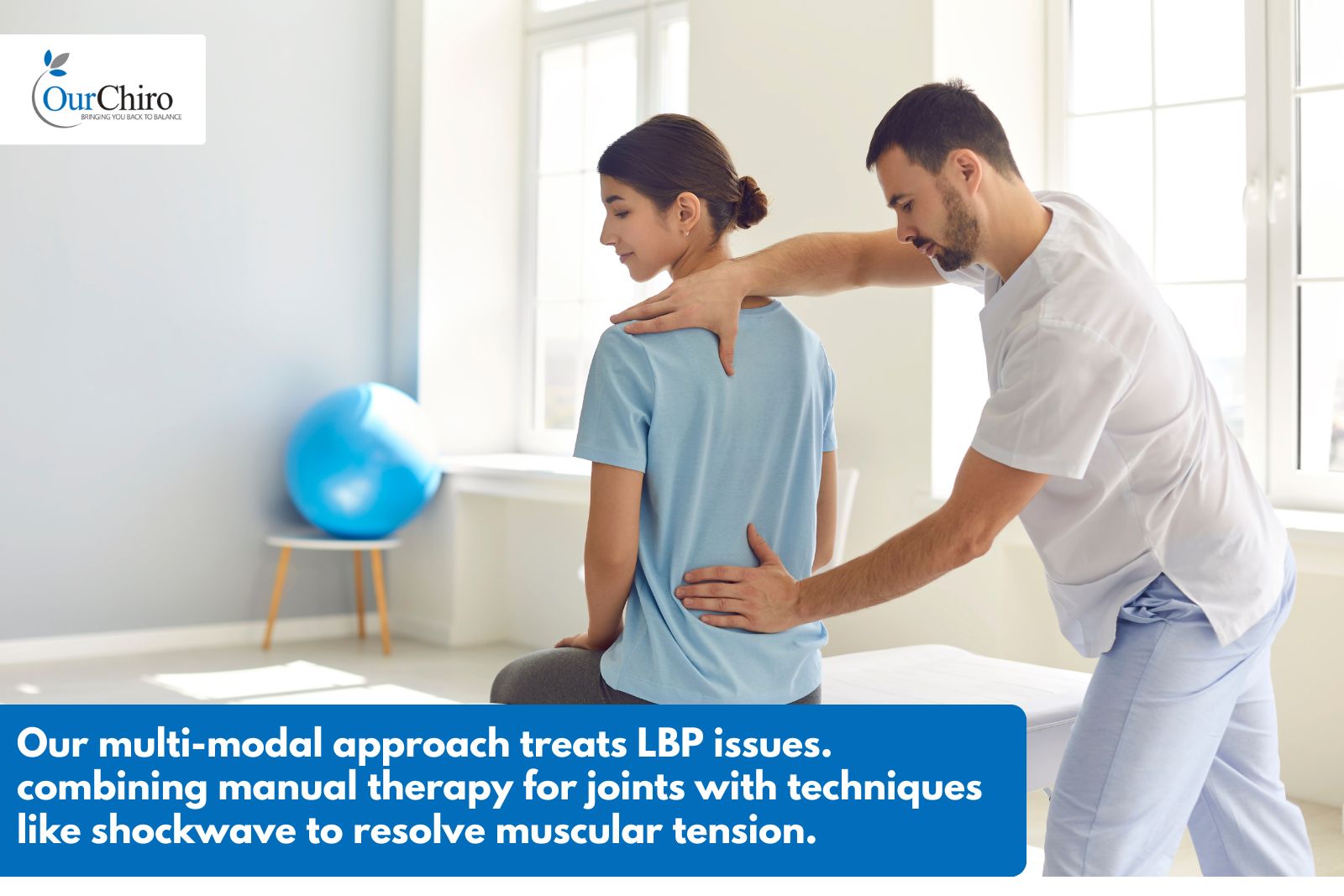
The foundational element of chiropractic care for LBP is often the use of manual adjusting, or spinal manipulation. The lumbar spine is a complex structure of vertebrae and joints that are essential for movement and support. When a joint becomes restricted, it can alter the mechanics of the back, leading to pain and muscle tension.
Dr. Nash explains the function of this core technique: “We could use manual adjusting which means mobilising around the joint to help restore its function to get the patient out of pain.”
A chiropractic adjustment is a precise, controlled force applied to a joint to restore its normal motion and improve its function. This can help to relieve pressure on the nerve roots, reduce inflammation, and decrease pain sensitivity.
The effectiveness of spinal manipulation for LBP is well-documented. A major review published in Chiropractic & Manual Therapies concluded that spinal manipulative therapy (SMT) is an effective treatment option for both acute and chronic low back pain, showing significant pain reduction and functional improvement (Whedon et al., 2017). This robust evidence supports the inclusion of manual adjusting as a core component of LBP management.
Soft Tissue Work and Dry Needling
For many LBP sufferers, tight, spasmed, or chronically tense muscles contribute significantly to their discomfort. Addressing these soft tissue issues is a crucial step in the treatment plan.
Soft tissue work is essentially a targeted form of massage and manual therapy. Dr. Nash clarifies this element: “Soft tissue work is sort of like a massage or using massage techniques to actually help release the muscle.”
This work helps to improve blood flow, reduce muscle spasm, and increase the flexibility of the affected area, allowing the joints to move more freely.
In cases where muscle tension is deep or persistent, dry needling may be employed. This involves inserting a fine filament needle into a muscular trigger point to elicit a twitch response, which helps to release the knot and ease muscle pain.
“We could use as I said dry needling which gets into the muscle to help release the muscle if it’s really, really tight,” notes Dr. Nash. This technique can be highly effective in reducing chronic muscle tension that often accompanies joint dysfunction.
Advanced Modalities: Laser and Shockwave
Beyond manual and soft tissue techniques, we integrate advanced physical modalities to manage pain and accelerate healing.
Cold Laser Therapy: Low-level laser therapy (LLLT), or cold laser therapy, is a non-invasive treatment that uses specific wavelengths of light to interact with tissue and is thought to stimulate cellular processes. This can help to reduce pain and inflammation, particularly in cases of acute LBP.
“We would use some cold laser therapy if the patient is in acute pain or even with chronic pain,” says Dr. Nash, indicating its utility across different stages of a back injury.
Shockwave Therapy: Shockwave therapy involves delivering a series of high-energy acoustic pulses to an area of pain or injury. While often associated with tendon and ligament issues, it can be beneficial for LBP when the cause is related to trigger points and chronic tension in the deep gluteal and surrounding muscles.
“We could use shockwave therapy in and around the glute muscles,” explains Dr. Nash. This powerful modality can break down painful scar tissue and stimulate a healing response in chronic, stubborn muscle areas.
Taping Methods: Kinesio and Rigid Taping
Finally, taping methods are used as an adjunct to the primary treatment. They provide support, enhance proprioception (the body’s awareness of its position), and can help to guide the body towards better movement patterns.
“We could also use taping methods such as kinesio taping or rigid taping just to help restore that for proper function around the low back,” says Dr. Nash.
Kinesio Taping provides dynamic support without restricting the full range of motion. It can help to lift the skin and decompress the tissue beneath, potentially reducing swelling and providing light support.
Rigid Taping is used when stronger support and stabilisation are required, often to prevent excessive movement during the acute healing phase.
The judicious use of taping ensures that the benefits of the in-clinic treatment are maintained as the patient returns to their daily activities.
Personalised Care and Recovery
The blend of these techniques – manual adjusting, soft tissue work, dry needling, cold laser, shockwave, and taping – ensures that we provide a truly comprehensive and individualised approach. The core philosophy is to use the right tool for the right job, addressing all contributing factors to the patient’s LBP.
Dr Simon Nash (Chiropractor): “Our focus is on functional recovery. We want to get you moving better, feeling stronger, and understanding how to keep your back healthy long after you leave the clinic.”
This integrated strategy provides pain relief, restores mobility, and empowers patients with the knowledge and exercises they need for long-term spinal health. The goal is always to guide patients back to full function, reducing the likelihood of future recurrences.
Frequently Asked Questions (FAQs)
Q1: Is a chiropractic adjustment painful for lower back pain? A: A manual adjustment is generally not painful. It is a precise, quick movement that may result in a popping sound (a process called ‘cavitation’). If the area is acutely tender, your chiropractor will use gentler mobilisation techniques instead of a strong adjustment.
Q2: How quickly can chiropractic care fix my lower back pain? A: This varies greatly depending on the cause and severity of the pain. Acute muscle strains may feel better after a few sessions, while disc-related pain or chronic issues may require a longer course of care. Your chiropractor will provide an estimated recovery timeline after your initial assessment.
Q3: Can I receive dry needling if I’m afraid of needles? A: Dry needling is always optional. If you are uncomfortable with it, your chiropractor can use soft tissue techniques like massage and trigger point therapy instead, which can be equally effective.
Q4: Is soft tissue work just a massage? A: While it feels like a deep massage, chiropractic soft tissue work is highly targeted. It focuses on specific muscles and trigger points that are directly contributing to the mechanical dysfunction or pain in your lower back.
Q5: What’s the difference between Kinesio and rigid taping? A: Kinesio taping is stretchy and offers gentle support to facilitate movement and fluid drainage. Rigid taping is non-stretchy and is used to strongly restrict movement for stabilisation during the acute healing phase.
Q6: Can cold laser therapy be used on my skin? A: Yes, cold laser therapy is a non-thermal (pain-free) treatment that is applied directly to the skin over the affected area. It does not burn and is safe for use on soft tissues.
Q7: Is Shockwave therapy painful? A: Shockwave therapy can cause mild discomfort, often described as a deep ache, but it is typically well-tolerated. The intensity is adjusted to remain comfortable for the patient.
Book a Consult with Our Chiro Brisbane
We understand that living with lower back pain can be exhausting and frustrating. It can impact your sleep, your work, and your ability to enjoy time with family and friends. We hear you, and we know how debilitating it can feel when you can’t move without a jolt of pain.
At Our Chiro Brisbane, our experienced team is here to listen and help. We will conduct a thorough examination to pinpoint the precise cause of your pain and create a tailored treatment plan using the best combination of manual, soft tissue, and advanced techniques. Our goal is to empower you to move freely and live a life unhindered by back pain.
Don’t let Lower back pain control your life any longer. Take the first step toward relief and recovery.
Ready to start your journey to a pain-free back? Book an appointment today with Our Chiro Brisbane.
Interested in learning more about the range of care we offer? Explore our Chiropractic treatments page.
References
Paige, N. M., Miake-Lye, I. M., Booth, M. S., Beroes, J. M., Mardian, A. S., Dougherty, P., Branson, R., Tang, B., Morton, S. C., & Shekelle, P. G. (2017). Association of Spinal Manipulative Therapy With Clinical Benefit and Harm for Acute Low Back Pain: Systematic Review and Meta-analysis. JAMA, 317(14), 1451–1460. https://doi.org/10.1001/jama.2017.3086
Foster, N. E., Anema, J. R., Cherkin, D., Chou, R., Cohen, S. P., Gross, D. P., … & Van Tulder, M. (2018). Prevention and treatment of low back pain: evidence, challenges, and promising directions. The Lancet, 391(10137), 2368-2383. https://pubmed.ncbi.nlm.nih.gov/29573872/
Video Transcript
In the clinic, we uh treat lower back pain using uh a a few different techniques. So, we could use manual adjusting uh which means mobilising around the joint to help restore its function to get the patient out of pain. We could use uh soft tissue work or dry needling. Soft tissue work mean is is sort of like a massage or using massage techniques to actually help release the muscle. Uh we could use as I said dry needling um which gets into the muscle to help release uh the muscle if it’s really really tight. We would use some cold laser therapy um if the patient is in acute pain or even um with chronic pain. Uh we could use shockwave therapy um in and around the glute muscles. And we could also use taping methods such as kinesio taping or rigid taping just to help restore that for proper function around the low back.
This blog post was written and approved by Dr Simon Nash
Dr Simon Nash (M.Chiro, B.Chiro Sci.) is a chiropractor with over 20 years of clinical experience. He is a full professional member of Sports Medicine Australia (SMA) and Chiropractic Australia, and is AHPRA registered (CHI0000970189). Simon graduated from Macquarie University and is dual-registered to practise in Australia and Hong Kong.
He began his career in a multidisciplinary neurology-focused clinic in Sydney, developing a strong interest in treating headaches and migraines. Since 2006, he has operated Our Chiro Brisbane, now alongside his sisters Jessica and Rebecca.
Simon treats everyday injuries, workplace rehabilitation cases and complex presentations using a wide range of techniques. His sports medicine experience spans elite athletes including NRL and Rugby Union players, Olympians, and events like the Australian Open and Hong Kong 7s. He has also treated Guns N’ Roses during tour.


Disclaimer:
The information provided in this blog is for general informational purposes only and is not intended as medical advice. It should not be used to diagnose, treat, or replace professional consultation with a qualified healthcare provider. Always seek the advice of a chiropractor, GP, or other qualified health professional regarding any medical condition or treatment.
Click here to learn more about our editorial policy, that explains how content is created, fact-checked, and updated by qualified chiropractors and other health professionals.