

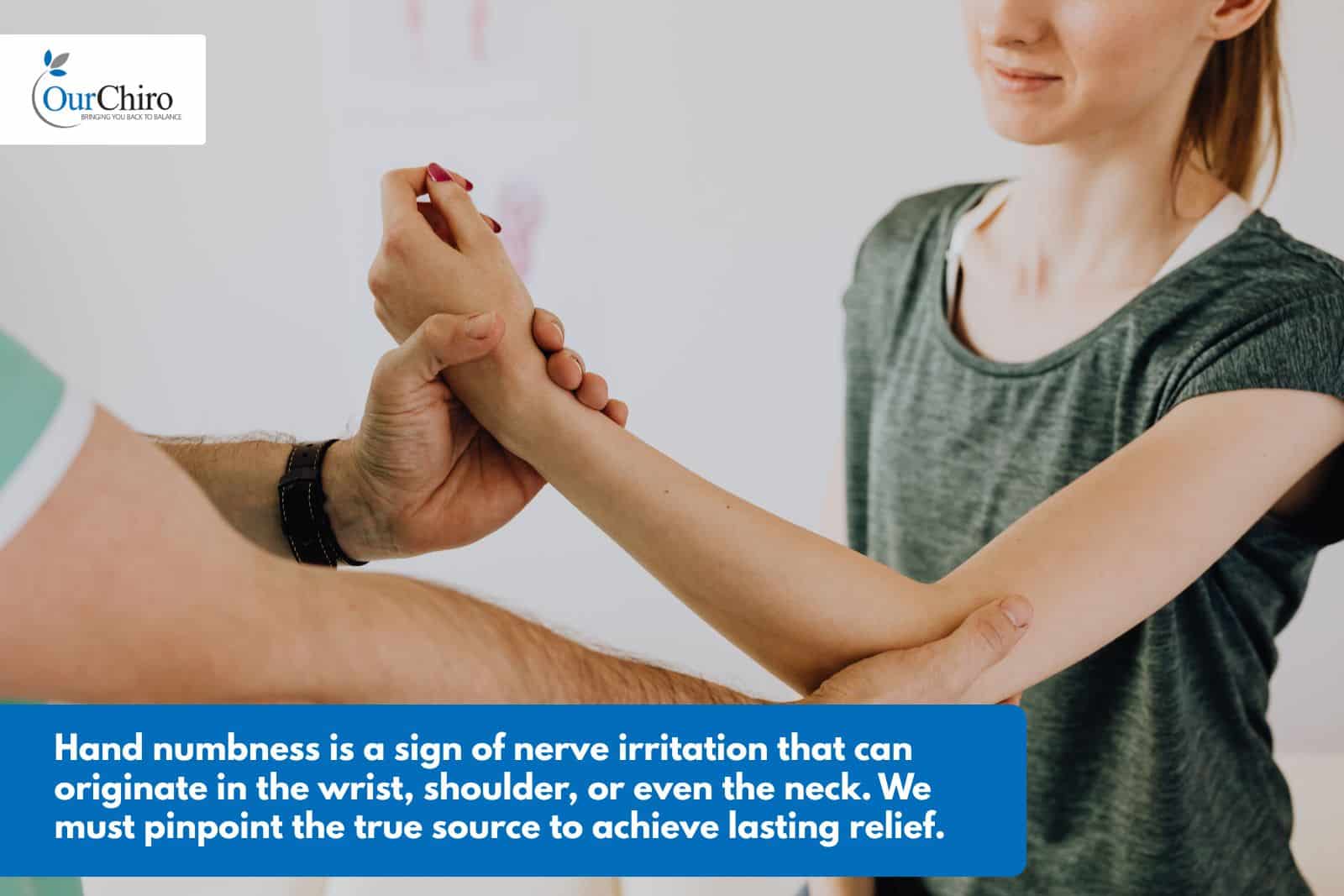
Hand numbness and tingling are not just annoying, they can be unsettling and significantly interfere with your daily life, making simple tasks like typing, holding a cup of coffee, or driving a genuine struggle. These symptoms are often a sign of nerve irritation or compression, which can originate in the hand and wrist, the shoulder, or even the neck. Understanding the cause is the first step toward finding effective relief.
In this article, Dr. Simon Nash (Chiropractor) discusses the various origins of hand numbness and nerve irritation, and the tailored chiropractic approaches that may help restore function and alleviate discomfort.
Please note: The information provided in this article is for general knowledge and informational purposes only, and does not constitute medical advice. It is essential to consult with a qualified healthcare professional for a diagnosis and personalised treatment plan.
Table of Contents
- Understanding Hand Numbness and Nerve Irritation
- Postural Causes of Nerve Irritation
- Localised Causes: Carpal Tunnel Syndrome and Biomechanical Dysfunction
- The Chiropractic Approach to Hand Numbness
- Understanding Treatment and Recovery
- Frequently Asked Questions (FAQs)
- Book a Consult with Our Chiro Brisbane
- References
- Video Transcript
Understanding Hand Numbness and Nerve Irritation
Hand numbness, often accompanied by tingling or a “pins and needles” sensation, is medically known as paraesthesia. These symptoms arise when the nerves supplying sensation to the hand are irritated or compressed at any point along their pathway, from the neck (cervical spine) down to the wrist and hand. The severity can range from a mild, occasional annoyance to chronic, debilitating pain and weakness.
Dr. Simon Nash (Chiropractor) confirms that this is a frequent presentation in the clinic:
“We see this quite often in the clinic. Obviously it comes from a great range of different origins.”
Identifying where the irritation is occurring is crucial for effective treatment. Nerve compression can stem from issues related to posture, repetitive motion, injury, or underlying spinal problems.
Postural Causes of Nerve Irritation
One of the most common origins of hand and arm nerve symptoms is related to poor posture, particularly for those who spend long hours working at a desk. When we sit in a slumped or strained position, tension can build up in the muscles of the neck and upper back, directly impacting the nerves that travel down the arm.
Dr. Nash highlights the link between desk work and muscle tension:
“Whether it’s postural stuff, so for example, people that sit at a desk, they might end up with tightness through the scalene muscles, tightness through the trapezius muscles, and then that postural strain starts to get tingling in the hand.”
The scalene muscles in the front of the neck and the trapezius muscles in the upper back and shoulder region can become chronically tight, leading to a condition sometimes referred to as Thoracic Outlet Syndrome (TOS). In TOS, the nerves and blood vessels are compressed as they pass through a narrow space between the collarbone and the first rib. This compression can cause numbness, tingling, and pain in the arm and hand.
Chiropractic care for these postural issues is focused on addressing the underlying mechanical and functional problems of the spine and surrounding musculature.
“We would look at that as an orthopedic problem and a structural and a functional problem and actually help restore with the movement up around the cervical spine and in the thoracic spine,” Dr. Nash explains.
Localised Causes: Carpal Tunnel Syndrome and Biomechanical Dysfunction
Beyond issues in the neck and shoulder, the nerve irritation can be localised in the arm, wrist, or hand itself.
Carpal Tunnel Syndrome (CTS)
Carpal Tunnel Syndrome is a widely recognised condition where the median nerve, which runs from the forearm into the hand, becomes compressed or squeezed at the wrist. The carpal tunnel is a narrow passageway of ligaments and bones at the base of the hand. Swelling or irritation in this tunnel can press on the median nerve, leading to numbness and tingling in the thumb, index finger, middle finger, and half of the ring finger.
CTS is often linked to repetitive use injuries, where repeated wrist and hand movements cause inflammation and subsequent nerve compression.
“If we were looking at something for example that was more local, so around the uh around the wrist, we’d be looking at carpal tunnel,” Dr. Nash notes.
Biomechanical Dysfunction
Repetitive actions, whether from sport or occupation, can lead to biomechanical dysfunction—an issue with how the joints and muscles are moving and interacting—that causes local irritation.
Dr. Nash specifies common activities that can contribute to this type of injury:
“We’d be looking at the biomechanical dysfunction of the wrist, whether that comes from sporting injuries or whether that comes again from repetitive use injuries. So sometimes we would see tennis players, badminton players, chefs, people that use their hands can sometimes have a lot of more local pain around the carpal tunnel and around that area and then you would end up with that biomechanical dysfunction around that.”
This dysfunction can involve tightness in the forearm muscles, joint restrictions in the wrist bones, or tendon irritation, all of which can increase pressure on the delicate nerves.
The Chiropractic Approach to Hand Numbness
Chiropractic care for hand numbness and nerve irritation is highly individualised, depending on whether the origin is postural (in the neck/shoulder) or localised (in the wrist/hand). The primary goal is to restore normal function and remove the physical compression or irritation on the nerve.
For issues originating in the neck and upper back, treatment focuses on restoring mobility and reducing muscle tension:
- Spinal mobilisation: Gentle techniques are used to improve the movement of the cervical and thoracic vertebrae, reducing irritation on the nerve roots.
- Soft tissue therapy: Addressing tightness in muscles like the scalenes and trapezius through massage, stretching, and dry needling can directly relieve tension and nerve compression.
For localised issues like Carpal Tunnel Syndrome or other wrist/hand dysfunctions, the approach is focused on the local area:
- Physical therapy: Techniques aimed at restoring proper movement and alignment of the wrist and hand joints.
- Activity modification advice: Guidance on changing work or sport habits to reduce repetitive strain and allow the area to heal.
- Kinesio taping: Application of Kinesio taping or rigid tape can support the wrist, reduce inflammation, and help maintain proper posture or alignment during activity.
A systematic review published in The Cochrane Library found that manual therapies (including spinal manipulation and mobilisation) may improve pain and function for chronic mechanical neck disorders, which can be the root cause of nerve irritation leading to hand numbness. (Gross et al., 2015)
Dr. Nash explains the multi-modal approach Our Chiro Brisbane takes:
“We’d aim to restore that function using physical therapy. We could use activity modification, sometimes needling and taping.”
Furthermore, advanced modalities are often employed to accelerate healing and manage inflammation:
- Cold laser therapy: This is a non-invasive, pain-free treatment that uses specific wavelengths of light to interact with tissue and reduce inflammation, a key component of nerve irritation.
- Shockwave therapy: This non-surgical treatment can be used for chronic tendon and soft tissue issues around the wrist and hand that may contribute to nerve entrapment.
“We’ve also got access to cold laser and shockwave therapy. So, there’s a lot of different ways to treat it depending on the cause of it.”
A study in the Journal of Clinical Medicine reported that extracorporeal shockwave therapy (ESWT) can be a safe and effective treatment option for mild to moderate carpal tunnel syndrome, demonstrating a specific, local application of this technology. (Zhang et al., 2023)
Understanding Treatment and Recovery
The recovery time for hand numbness and nerve irritation varies greatly depending on the cause, how long the symptoms have been present, and the patient’s adherence to the treatment plan. Nerve healing is a gradual process.
If the issue is primarily postural, changes in movement and spinal function may bring relief relatively quickly. For more severe conditions, such as advanced Carpal Tunnel Syndrome or a significant disc issue in the neck, the healing process may take longer.
“We want to make sure that the irritation to the nerve is being taken away, so that the patient can regain full sensation and function in their hands,” Dr. Nash advises.
The treatment plan is an active partnership. While the chiropractor works to restore function in the clinic, the patient’s commitment to prescribed stretches, exercises, and activity modification at home is vital for long-term success.
Frequently Asked Questions (FAQs)
Q1: Why is my hand numbness worse at night? A: Symptoms often worsen at night because of sleeping positions that put pressure on the wrists (bent position) or the nerves in the neck and shoulder (awkward head or arm position).
Q2: Can stress or tension cause hand numbness? A: Yes, stress often leads to increased muscle tension in the neck and shoulders (trapezius and scalenes), which can compress the nerves that travel down the arm, causing tingling and numbness.
Q3: How long does it take for chiropractic treatment to help hand numbness? A: It varies greatly. Mild, acute issues might improve in a few visits, while chronic conditions like carpal tunnel syndrome or a significant disc problem may require a longer course of treatment over several weeks or months to achieve sustained relief.
Q4: Do I need surgery for Carpal Tunnel Syndrome? A: Not always. Chiropractic care and other conservative treatments like taping, specific exercises, and cold laser therapy are often effective for mild to moderate cases. Surgery is typically considered a last resort for severe, unresponsive cases.
Q5: Should I use a wrist brace for hand numbness? A: For carpal tunnel symptoms, a wrist brace can be very helpful, especially at night, as it keeps the wrist in a neutral position to reduce pressure on the nerve. Your chiropractor can advise on the best type and when to wear it.
Q6: Can poor keyboard and mouse setup cause these issues? A: Absolutely. An improper ergonomic setup can force your wrists and neck into strained positions, leading to repetitive strain injuries and nerve compression. Adjusting your workspace is a critical part of recovery.
Q7: Is it safe to continue exercising with hand numbness? A: It depends on the cause. Gentle, prescribed exercises are often beneficial. However, activities that involve heavy lifting, sustained gripping, or repetitive wrist movements may need to be temporarily modified or stopped. Always consult your healthcare provider.
Book a Consult with Our Chiro Brisbane
We understand that the constant tingling, burning, or numb sensation in your hands can be incredibly frustrating. It can make you feel weak, limit your independence, and even disrupt your sleep. It’s a symptom that demands attention.
At Our Chiro Brisbane, we are committed to moving beyond temporary fixes. Our experienced chiropractors will perform a thorough assessment to pinpoint the true origin of your nerve irritation, whether it’s an issue in your neck, shoulder, or wrist. We will then develop a bespoke treatment plan using a combination of techniques, from gentle mobilisation and soft tissue work to cutting-edge modalities like cold laser therapy. Our goal is to relieve your discomfort, restore full function, and empower you with the knowledge to prevent future episodes.
Don’t let hand numbness limit your life any longer. We’re here to help you get back to feeling comfortable and capable.
Take the first step towards relief: Book an appointment with one of our chiropractors today.
References
- Gross, A., Kay, T. M., Paquin, J.-P., Blanchette, S., Lalonde, P., Christie, T., Dupont, G., Graham, N., Burnie, S. J., Gelley, G., Goldsmith, C. H., Forget, M., Hoving, J. L., Brønfort, G., & Santaguida, P. L. (2015). Exercises for Mechanical Neck Disorders. Cochrane Database of Systematic Reviews, 1(1).https://doi.org/10.1002/14651858.cd004250.pub5
- Zhang, L., Yang, T., Pang, L., Li, Y., Li, T., Zhang, C., Yao, L., Li, R., & Tang, X. (2023). Effects of Extracorporeal Shock Wave Therapy in Patients with Mild-to-Moderate Carpal Tunnel Syndrome: An Updated Systematic Review with Meta-Analysis. Journal of Clinical Medicine, 12(23), 7363. https://doi.org/10.3390/jcm12237363
Video Transcript
So, can chiropractic help with hand numbness and nerve irritation? So, we see this quite often in the clinic. Um, obviously it comes from a great range of different origins. So, whether it’s postural stuff, so for example, people that sit at a desk, they might end up with tightness through the scalene muscles, tightness through the trapezius muscles, and then that postural strain starts to get tingling in the hand. So, we would look at that as an orthopedic problem and a structural a functional problem. and actually help restore with the movement up around the cervical spine and in the thoracic spine. If we were looking at something for example that um was more local, so around the uh around the wrist, we’d be looking at carpal tunnel, we’d be looking at the biomechanical dysfunction of the wrist, whether that comes from sporting injuries um or whether that comes again from repetitive use injuries. So sometimes we would see uh tennis players, badminton players, chefs, people that use their hands can sometimes have a lot of more local pain um around the carpal tunnel and around that area and then you would end up with that biomechanical dysfunction around that. So we’d aim to restore that function um using physical therapy. We could use activity modification, sometimes needling um also taping. Um, we’ve also got access to cold laser and um, shockwave therapy. So, there’s a lot of different ways to treat it depending on the cause of it.
This blog post was written and approved by Dr Simon Nash
Dr Simon Nash (M.Chiro, B.Chiro Sci.) is a chiropractor with over 20 years of clinical experience. He is a full professional member of Sports Medicine Australia (SMA) and Chiropractic Australia, and is AHPRA registered (CHI0000970189). Simon graduated from Macquarie University and is dual-registered to practise in Australia and Hong Kong.
He began his career in a multidisciplinary neurology-focused clinic in Sydney, developing a strong interest in treating headaches and migraines. Since 2006, he has operated Our Chiro Brisbane, now alongside his sisters Jessica and Rebecca.
Simon treats everyday injuries, workplace rehabilitation cases and complex presentations using a wide range of techniques. His sports medicine experience spans elite athletes including NRL and Rugby Union players, Olympians, and events like the Australian Open and Hong Kong 7s. He has also treated Guns N’ Roses during tour.


Disclaimer:
The information provided in this blog is for general informational purposes only and is not intended as medical advice. It should not be used to diagnose, treat, or replace professional consultation with a qualified healthcare provider. Always seek the advice of a chiropractor, GP, or other qualified health professional regarding any medical condition or treatment.
Click here to learn more about our editorial policy, that explains how content is created, fact-checked, and updated by qualified chiropractors and other health professionals.