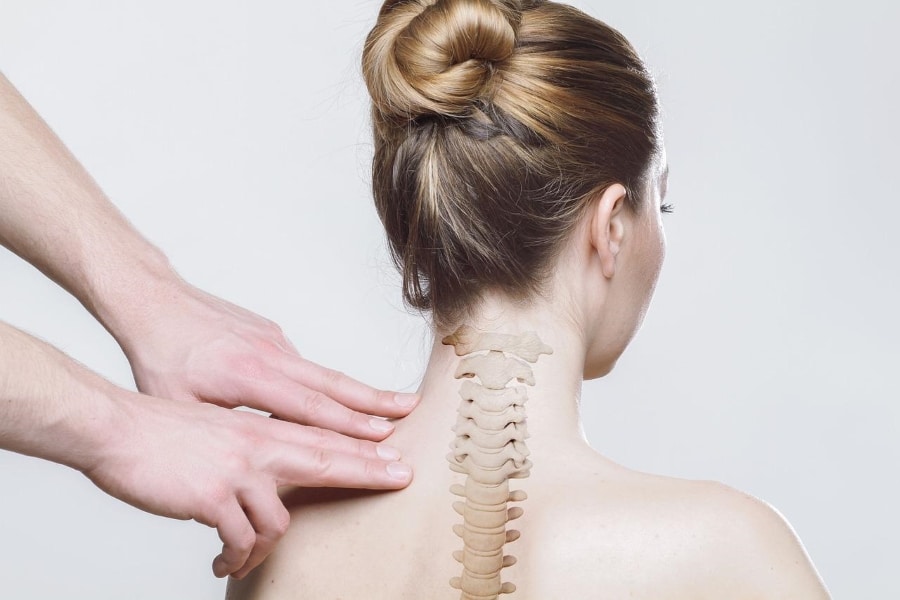

As one of the most commonly diagnosed spinal conditions, a bulging disc can be both confusing and genuinely disruptive to everyday life. Whether you are dealing with localised back pain, shooting sensations down your leg, or numbness in your arm, a bulging disc may well be at the root of it. This fact sheet is designed to help you understand what a bulging disc actually is, why it causes pain in different parts of the body, and how chiropractic care addresses the problem at its source rather than simply managing symptoms.
In this article, Dr Simon Nash (Chiropractor) explains the anatomy behind a bulging disc, the referred pain it can generate, and the range of treatment techniques used at Our Chiro Brisbane to support recovery.
Medical Disclaimer: The information provided in this article is for general knowledge and informational purposes only and does not constitute medical advice. It is essential to consult with a qualified healthcare professional, such as the team at Our Chiro Brisbane, for an accurate diagnosis and personalised treatment plan.
Table of Contents
- What is a Bulging Disc?
- How a Bulging Disc Causes Pain
- Referred Pain: Why Your Leg or Arm Might Be the Problem
- What Causes a Disc to Bulge?
- How Chiropractic Care Can Help
- Innovative Treatment Modalities at Our Chiro
- Frequently Asked Questions (FAQs)
- Book a Consult with Our Chiro Brisbane
- References
- Video Transcript
What is a Bulging Disc?
Between each vertebra in your spine sits an intervertebral disc, a small but vital structure that acts as a shock absorber and allows for movement and flexibility. Each disc has two main components: the annulus fibrosus, a tough outer layer made up of fibrous rings, and the nucleus pulposus, a soft, gel-like centre.
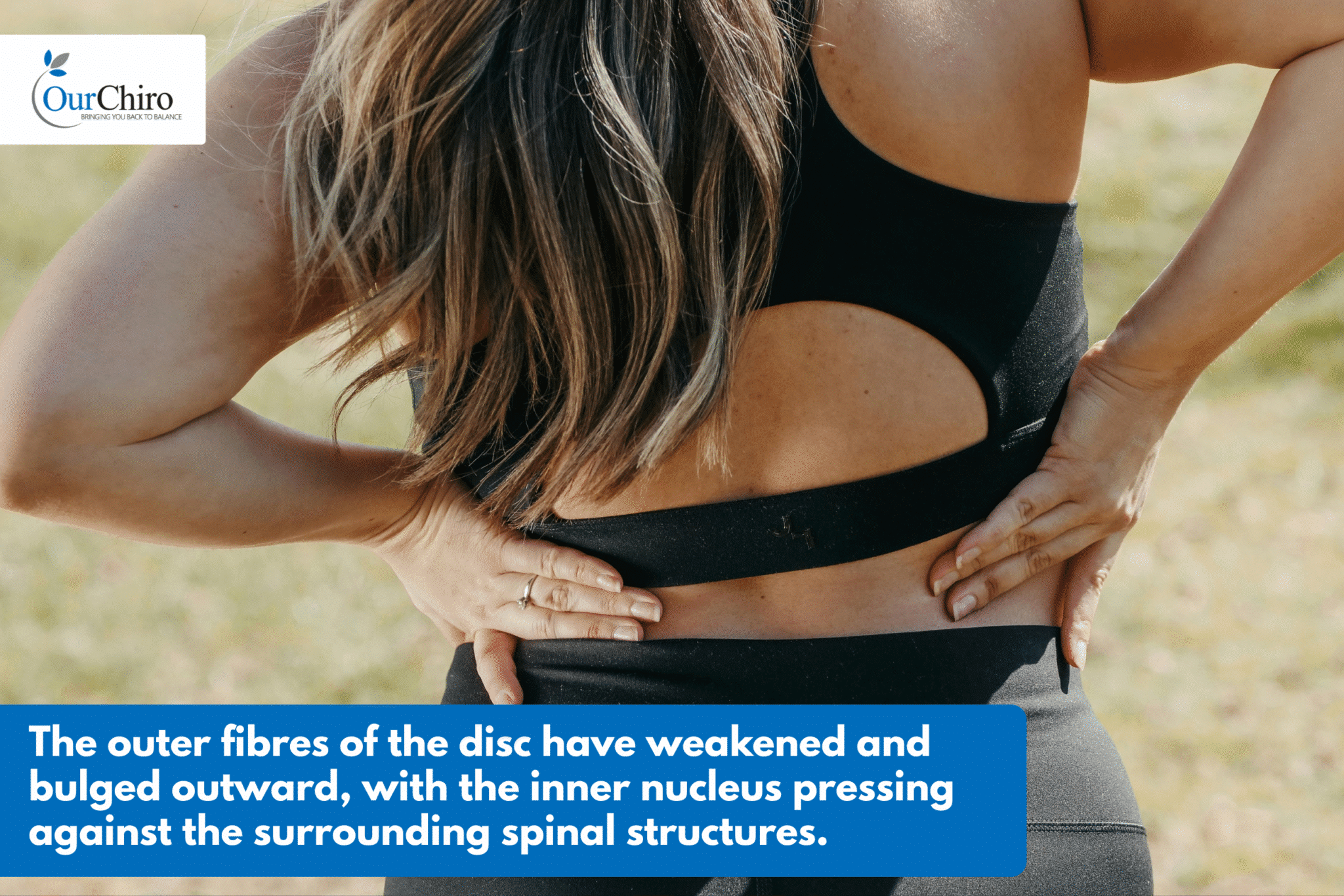
A bulging disc occurs when those outer fibres weaken and allow the inner nucleus to push outward against the disc wall, causing it to extend beyond its normal boundary. Unlike a herniated disc, where the outer layer fully tears and the inner material leaks out, a bulging disc remains intact but protrudes in a way that can put pressure on nearby nerves or spinal structures.
“A question that we often get asked at the clinic is, what is a bulging disc? So a bulging disc is where the outer fibres of the disc actually collapse or bulge out, and then the inner part of the disc, the nucleus, pushes out against that structure,” explains Dr Simon Nash.
While bulging discs can occur anywhere along the spine, they are most commonly found in the lumbar (lower back) and cervical (neck) regions, where the spine carries the most load and performs the greatest range of movement.
How a Bulging Disc Causes Pain
Not every bulging disc causes pain. In fact, many people have a bulge on imaging without any symptoms at all. Pain tends to arise when the bulge is large enough to compress or irritate a nearby nerve root. When this happens, the result can be far more than localised back or neck pain. You may experience a cascade of symptoms that radiate well away from the spine itself.
The most recognisable pattern is a sharp, burning, or electric sensation that travels along the pathway of the affected nerve. In the lumbar spine, this often presents as pain running through the buttock and down the leg, a condition many people know as sciatica. In the cervical spine, the same mechanism can send pain, weakness, or tingling down the arm and into the fingers.
Expert Insight from Dr Simon Nash (Chiropractor):
“The disc itself is essentially a communication issue between the brain and the rest of the body. When a bulging disc irritates a nerve root, the brain perceives that signal as pain anywhere along that nerve’s pathway. Treating just the symptom site misses the entire point of what is happening structurally.”
Referred Pain: Why Your Leg or Arm Might Be the Clue
One of the most important concepts in understanding a bulging disc is referred pain. This is where the brain perceives pain in one area of the body while the actual structural problem is elsewhere entirely.
“It’s sometimes associated with referred pain, such as leg pain or arm pain, so tingling down the arm or pain down the arms,” Dr Nash notes. This is why patients are often surprised to learn that the calf pain or tingling hand they have been living with may have its origin in the spine, not in the limb itself.
This distinction matters enormously for treatment. Applying therapies only to the site of perceived pain, without addressing the spinal source, tends to produce short-term relief at best. An accurate clinical assessment is the essential first step, something the team at Our Chiro Brisbane places at the centre of every patient consultation.
A systematic review published in the European Spine Journal confirmed that nerve root compression from lumbar disc herniation is strongly associated with radiating leg pain and neurological deficits, underscoring the importance of spinal assessment in patients presenting with limb symptoms (Kreiner et al., 2014).
What Causes a Disc to Bulge?
Bulging discs rarely happen overnight. They are most often the result of a gradual process of wear, combined in some cases with a specific incident that tips the disc over a threshold it can no longer manage.
The two most common contributing factors are poor biomechanics and trauma. Poor biomechanics refers to the way repetitive, asymmetrical, or poorly supported movement places uneven load on the spine over time. This might include prolonged sitting with a forward-head posture, habitual lifting with a rounded lower back, or years of sedentary desk work that allows the stabilising muscles around the spine to weaken.
Trauma, whether a sudden heavy lift, a motor vehicle accident, or a sporting injury, can accelerate disc damage significantly, compressing or twisting the disc in a way the outer fibres cannot absorb.
Other contributing risk factors include age-related dehydration of the disc, genetic predisposition to disc degeneration, and occupational or lifestyle factors that place sustained load on the spine.
Expert Insight from Dr Simon Nash (Chiropractor):
“A bulging disc is often the end result of a long conversation the spine has been trying to have with you. Poor movement patterns, weak stabilisers, and sustained postural load all add up over time. The disc bulge is the point at which that conversation becomes impossible to ignore.”
How Chiropractic Care Can Help
Once the assessment confirms a bulging disc as the source of your symptoms, treatment at Our Chiro Brisbane focuses on two core goals: reducing the inflammation around the affected area, and taking the mechanical pressure off the disc itself.
“So what we want to do when we see a disc bulge is to reduce the inflammation and try and take the pressure off the disc, which is often caused by poor biomechanics or trauma,” says Dr Nash.
This is achieved through a combination of hands-on and technology-assisted techniques, selected specifically for your presentation. The approach is never one-size-fits-all. A patient with an acute, inflamed disc requires different initial management than someone dealing with a chronic low-grade bulge that has been building for years.
Chiropractic care in this context is genuinely multi-modal. It addresses not just the disc itself, but the surrounding musculature, the joint mechanics of the spine, the nervous system’s response to irritation, and the postural and movement habits that contributed to the problem in the first place.
Research published in the Journal of Manipulative and Physiological Therapeutics found that spinal manipulative therapy is effective in reducing pain and improving function in patients with lumbar disc herniation with radiculopathy, particularly when combined with multimodal conservative care (McMorland et al., 2010).
Innovative Treatment Modalities at Our Chiro
The range of techniques available at Our Chiro Brisbane reflects both the complexity of disc-related conditions and the importance of tailoring care to each individual. Dr Nash outlines some of the key approaches used.
- Traction is often one of the first interventions considered for a bulging disc. By gently decompressing the spine, traction creates space between the vertebrae, reducing the pressure on the affected disc and encouraging the bulge to retract away from the nerve.
- Gentle mobilisations allow the chiropractor to restore movement to the segments of the spine surrounding the disc, reducing the compensatory stiffness that often develops when a person guards against pain.
- Dry needling targets trigger points and areas of muscular hypertonicity that frequently develop in response to disc-related pain. By releasing tension in these tissues, it helps to normalise the load distribution around the spine.
- Active release techniques address the adhesions and restrictions in soft tissue that accumulate over time, restoring the normal glide and function of muscles and connective tissue around the affected area.
- Taping methods, whether rigid strapping or kinesio tape, can provide proprioceptive support, offload specific structures, and help patients maintain better postural alignment between appointments.
“So some of the things we might do is traction, we might do some gentle mobilisations around that area, we might try and reduce the inflammation around the muscles. So we might use dry needling, some active muscle release techniques, some taping methods, whether it be rigid or kinesio taping. So there’s lots of different techniques to treat a bulging disc, and it’s usually quite successful when we do that,” says Dr Nash.
Frequently Asked Questions (FAQs)
Q1: Is a bulging disc the same as a herniated disc? Not quite. A bulging disc means the outer fibres of the disc have weakened and pushed outward, but the disc remains intact. A herniated disc involves a tear in the outer layer, through which the inner nucleus material escapes. Bulging discs are generally less severe, though both can cause significant pain if they irritate a nerve.
Q2: Will a bulging disc heal on its own? Many bulging discs do improve over time, particularly with appropriate conservative care. The disc’s ability to self-correct depends on age, the degree of the bulge, the presence of nerve involvement, and lifestyle factors. Early, targeted treatment tends to produce better outcomes than waiting.
Q3: Can chiropractic treatment make a bulging disc worse? In skilled hands, chiropractic care is a safe and effective treatment for disc-related conditions. Your chiropractor will assess the severity of the bulge, the level of nerve involvement, and any contraindications before selecting techniques. Low-force options are always available for those who are particularly acute or sensitive.
Q4: How long will it take to recover from a bulging disc? Recovery timelines vary considerably depending on how long the disc has been symptomatic, the degree of nerve irritation, and how well the patient responds to treatment. After your initial assessment, Dr Nash will provide a clear treatment plan with realistic expectations for your specific presentation.
Q5: What can I do at home to support my recovery? Specific rehabilitation exercises, postural advice, and movement guidance will be part of your treatment plan. In general, staying gently active within your pain tolerance, avoiding prolonged sitting or static postures, and applying heat to relieve muscle tension are commonly recommended. Your chiropractor will tailor advice to your individual case.
Q6: Is the traction treatment uncomfortable? Traction is typically a very comfortable treatment. Most patients find it relieving rather than painful, as it gently decompresses the spinal segments and reduces the pressure that has been driving their symptoms.
Book a Consult with Our Chiro Brisbane
We understand that living with a bulging disc is exhausting. The pain is one thing, but it is the ripple effects that really take their toll: broken sleep, the inability to sit through a meal with your family, having to think twice before picking up your child, or dreading the morning commute. You should not have to manage on painkillers and hope.
At Our Chiro Brisbane, we take a thorough, evidence-based approach to disc-related conditions. We want to understand the full picture of your spine, your movement habits, and your goals so that we can build a treatment plan that addresses the root cause and gives you the best possible chance of long-term recovery.
Take the first step back to mobility. Book your appointment online at ourchiro.com.au or call us on 07 3257 0399 to find out how we can help.
References
Kreiner, D. S., Hwang, S. W., Easa, J. E., Resnick, D. K., Baisden, J. L., Bess, S., Cho, C. H., DePalma, M. J., Dougherty, P., Fernand, R., Ghiselli, G., Hanna, A. S., Lamer, T., Lisi, A. J., Mazanec, D. J., Meagher, R. J., Nucci, R. C., Sciubba, D. M., Sharma, A. K., Standaert, C. J., Timmons, R. B., Truckenbrodt, A. M., Truss, M. F., & Wang, J. C. (2014). An evidence-based clinical guideline for the diagnosis and treatment of lumbar disc herniation with radiculopathy. The Spine Journal, 14(1), 180-191. https://doi.org/10.1016/j.spinee.2013.08.003
McMorland, G., Suter, E., Casha, S., du Plessis, S. J., & Hurlbert, R. J. (2010). Manipulation or microdiskectomy for sciatica? A prospective randomized clinical study. Journal of Manipulative and Physiological Therapeutics, 33(8), 576-584. https://doi.org/10.1016/j.jmpt.2010.08.013
Video Transcript
A question that we often get asked at the clinic is, what is a bulging disc, and can a chiropractor help? So a bulging disc is where the outer fibres of the disc actually collapse or bulge out, and then the inner part of the disc, the nucleus, pushes out against that structure. It’s sometimes associated with referred pain, such as leg pain or arm pain, or radiculopathy, so tingling down the arm or pain down the arms.
So what we want to do when we see or treat a disc bulge is to reduce the inflammation and try and take the pressure off the disc, which is often caused by poor biomechanics or trauma. So some of the things we might do is traction, we might do some gentle mobilisations around that area, we might try and reduce the inflammation around the muscles. So we might use dry needling, some active muscle release techniques, some taping methods, whether it be rigid or kinesio taping. So there’s lots of different techniques to treat a bulging disc, and it’s usually quite successful when we do that.
This blog post was written and approved by Dr Simon Nash
Dr Simon Nash (M.Chiro, B.Chiro Sci.) is a chiropractor with over 20 years of clinical experience. He is a full professional member of Sports Medicine Australia (SMA) and Chiropractic Australia, and is AHPRA registered (CHI0000970189). Simon graduated from Macquarie University and is dual-registered to practise in Australia and Hong Kong.
He began his career in a multidisciplinary neurology-focused clinic in Sydney, developing a strong interest in treating headaches and migraines. Since 2006, he has operated Our Chiro Brisbane, now alongside his sisters Jessica and Rebecca.
Simon treats everyday injuries, workplace rehabilitation cases and complex presentations using a wide range of techniques. His sports medicine experience spans elite athletes including NRL and Rugby Union players, Olympians, and events like the Australian Open and Hong Kong 7s. He has also treated Guns N’ Roses during tour.


Disclaimer:
The information provided in this blog is for general informational purposes only and is not intended as medical advice. It should not be used to diagnose, treat, or replace professional consultation with a qualified healthcare provider. Always seek the advice of a chiropractor, GP, or other qualified health professional regarding any medical condition or treatment.
Click here to learn more about our editorial policy, that explains how content is created, fact-checked, and updated by qualified chiropractors and other health professionals.